Showing posts with label Victoria Hinshaw. Show all posts
    Showing posts with label Victoria Hinshaw. Show all posts

    Friday, December 13, 2013

    Visiting The Household Cavalry Museum


    Opened in 2007 by Her Majesty, Queen Elizabeth II, the Household Cavalry Museum is located in Horse Guards, with an entrance off the Parade. Victoria here, looking forward to another look at the HCM when the Wellington Tour visits on Saturday, September 6, 2014.  Kristine and I hope you can join us...and refer you HERE for the complete details on the itinerary, costs and the fine print. 

     
    Horse Guards, Whitehall
     
     
    The history of the Household Cavalry goes back at least 300 years.  Though we are most aware of these soldiers in their colorful traditional uniforms as mounted sentinels at Horse Guards, as they change the guard at Buckingham Palace, and as escorts of the Queen on grand official occasions, the members alternate between active service on armoured vehicles in the “regular army” and ceremonial duties.


    A closer view; the Parade is through the central arch
      

    The Museum provides the history of the Horse Guards Building, designed by William Kent and completed by John Vardy in 1755, after Kent’s death.  The Duke of Wellington, as commander in chief of the British Army in the 19thCentury kept his office in Horse Guards until he retired shortly before his death in 1852.


    Currently, two regiments make up the Household Cavalry, the Life Guards and the Blues and Royals.  Originating after the 1660 Restoration of Charles II to the throne, they provided personal Security for the monarch. Throughout the 17th and 18thcenturies, the cavalry fought in many wars, in Holland, in Germany, in Portugal and Spain. At the Battle of Waterloo, the regiments served bravely, capturing a French Eagle, a prized standard with far-reaching symbolic importance. It was the bloodiest battle of their history.


    Museum Entrance, opening onto the Parade
     
    What everyone was looking at on July 11, 2013, on the Parade
     
     
    The museum also chronicles the service of the Household Cavalry regiments in the Crimean and Boer Wars, among other engagements.  In WWI, WWII, and in numerous later conflicts, the regiments performed their duties in armoured cars, in tanks, and in helicopters.
     
     
    In the Museum
     
     
    Ceremonial Uniforms


    The horses get their due!!
     

    The museum covers the choice and training of the horses, a matter of great interest to many of us who love the sleek mounts, groomed to perfection and amazingly well behaved.  Each year, the horses are named with the same initial, thus preserving the year of their arrival in the Cavalry.  As an example, from the museum guidebook, “… Invader, Imogene and India arrived in 2008 and Jubilee Jenna and Jupiter in 2009.”  After an average of six months training, the four- or five-year old “recruits” serve for another 14 to 16 years, before withdrawal to a  private stable or a retirement home.


    The Saga of Waterloo, June 18, 1815

     
    The cavalry commander at the Battle of Waterloo was Henry Paget, Earl of Uxbridge and later, 1st Marquess of Anglesey. As the battle wound down, Paget sat on his horse beside the Duke of Wellington when a cannon shot shattered his leg.  Supposedly he said, “By God, sir, I’ve lost my leg.”  Wellington reportedly replied coolly, “By God, sir, so you have.”  After the amputation, Paget urged many improvements in the making of prosthetics for walking and riding.  He served the government and the army for another 37 years before finally passing away in 1854.  One of Paget’s artificial limbs is on display in the Museum.


    For a few weeks each summer, the Household Cavalry conducts a retreat for the members and the horses at the Norfolk seashore – which is the reason that in my photographs taken in July 2013, their substitutes, members of the King’s Troop Royal Horse Artillery take over, wearing their black ceremonial uniforms based on those of the Hussars at the Battle of Waterloo almost 200 years ago. 


    The Duke of Wellington's office as Commander-in-Chief of the British Army was above the center arch leading from Horse Guards' Whitehall façade to the parade ground.  The display photographed above depicts the final departure of the Duke from his position shortly before he died in 1852.  He was 83 years of age and had served his nation for 65 years.


    The website for the Household Cavalry Museum is here.
     
    Join us on The Wellington Tour!


    Friday, December 6, 2013

    Victoria Station and the Grosvenor Hotel


    Guoman Grosvenor Hotel

    The Wellington Tour, 4-14 September, 2014, will begin at the Guoman Grosvenor Hotel, 101 Buckingham Palace Road. The hotel is connected to Victoria Station, home of several rail and tube lines, plus hundreds of busses, coaches, and taxis.  It is super-convenient and appears quite lovely in its newly restored state.

    Victoria Station with Grosvenor Hotel at far right
     
    Map of Victoria Station neighborhood
    Station and hotel at red marker
    Square tan building just under words 'Green Park' is Buckingham Palace
    Apsley house at the far left upper corner
     
      
    The little map above shows the position of Victoria Station and the hotel, which you can see on any London map.  I can't imagine any more efficient location for almost every London attraction.
     
     
    Victoria Station interior
     
    Victoria Station itself is the second busiest in London (after Waterloo Station), with many rail lines to destinations in south and southeast England, including the Gatwick Express.  The Circle and District tube lines and the Victoria line stop here, and the Victoria Coach Terminal is adjacent.  The station has many shops, bars, and food sources, right at hand.  An upgrade of the facility is planned for the next few years, to include more escalators and improved accessibility.
      

    Guoman Grosvenor Hotel
     
    The hotel has been newly refurbished and updated, at a cost of  £20 million. The Grosvenor (not to be confused with Grosvenor House, another London hotel on Park Lane) was opened in 1862, one of the earliest of London's Victorian Railway Hotels built beside railroad stations.


    Many of these old hotels had declined into disuse in the past decades, and the Guoman Grosvenor is not the only one to be newly redone.  I recently wrote about the St. Pancras Renaissance hotel, formerly the Midland Grand Hotel, and the Great Northern Hotel at King's Cross, both on Euston Road, here
     
     
    Réunion Bar
     
                    
    In addition to meeting rooms, the bar (above), a gym, a business center, and the Grand Imperial Cantonese Restaurant, the hotel promises all 21st century amenities.  Additionally, the adjacent Victoria Station complex houses many restaurants and a shopping arcade.
     
    Guoman Grosvenor Hotel
     
     
    The hotel website is here.  Hope to see you on this street in September, 2014.
     
    For details on the Wellington Tour, click here.


    Friday, November 29, 2013

    The Wellington Tour: Frogmore House...in Windsor Great Park

    The Wellington Tour will visit Frogmore House on  September 13, 2014, a special treat,  for all of you can come with Kristine and me, Victoria, on our great adventure.  For all the details on the tour, click here.


    Frogmore House, from the lake

    For the Frogmore House website, click here.


    Aerial View, House is center right

    Frogmore House has served as a sort of refuge for various members of the royal family for several centuries.  The property became part of the royal holdings in the 16th century and was leased out to others. The land was acquired because it was adjacent to Windsor Great Park, though it was as marshy as its name indicates.  Several houses were built  by the Aldworth family, and the larger, known as Great Frogmore, was eventually leased to the Duke of Northumberland, (1665-1716), who was the natural son of Charles II and the Duchess of Cleveland. Eventually it was purchased for '
    Queen Charlotte (1744-1818), wife of George III, in 1792.


    Queen Charlotte, c. 1789-90, by Sir Thomas Lawrence
    National Gallery, London
     
     
     Charlotte and her daughters often fled to Frogmore to escape from the confines of palaces and castles, to this comparatively modest house where they could enjoy a bit more relaxation.  Queen Charlotte was an avid gardener and brought a number of unusual plants to this estate. Several of the princesses painted or sketched works shown here.
     
    For a brief segment of the conversation of HRH Charles, Prince of Wales with the Royal Librarian about Frogmore interiors, click here.
     

    The Green Pavilion, 1817, from Pyne's Royal Residences
     
     
    The Green Pavilion has been restored to its look during Queen Charlotte's lifetime.  Upon her death, Frogmore was left to her eldest unmarried daughter, Princess Augusta, though most of the furnishings were sold for the benefit of all the princesses.
     
     
    The Mary Moser Room, photographer: Christopher Simon Sykes
    The Royal Collection © 2009 Her Majesty Queen Elizabeth II
     
     
    The flowered panels by artist Mary Moser (1744-1819) were commissioned by Queen Charlotte, who chose the artist's name for the room.  The unusual four-tier revolving bookstand at the right dates from this same period of time.
     
    After the death of Princess Augusta in 1840, the crown repurchased the estate and Queen Victoria gave it to her mother, Victoria, Duchess of Kent, as her home. Many alterations and modernizations were made once more and the Duchess presided over the redecoration of several principal rooms.
     
    The Duchess of Kent's Drawing Room, photographer: Derry Moore
    The Royal Collection © 2009 Her Majesty Queen Elizabeth II
     
     In addition to artistic interests, reading and stitching, the ladies who enjoyed the informality of Frogmore sometimes organized theatrical programs and concerts by their friends as well as professional musicians. I suspect that after seeing the grandeur of nearby Windsor Castle, we will thoroughly understand why time at Frogmore was so precious.

     
    The Colonnade
     
     All of the residents of Frogmore have enjoyed the garden, and like the rooms, re-imagination often reigned. After the Indian Mutiny, Lord Canning, Governor-General of India, presented an Indian Kiosk captured at Lucknow in 1858  to Queen Victoria who had it placed near the house.
     
     
    Indian Kiosk
     
     
    After the death of her mother and her husband, both in 1861, Queen Victoria often sought seclusion at Frogmore She loved the house and garden where  'all is peace and quiet and you only hear the hum of the bees, the singing of the birds'. She built a mausoleum for Prince Albert and herself on the grounds. It is rarely open to the public due to ongoing restoration projects. 
     
    Though no royals have lived at Frogmore for some time, it is often used for meetings and other activities.  Below is the family portrait taken at the reception held at Frogmore after the wedding of the Queen's eldest grandson to Autumn Kelly in 2008. 
     
     
    This image released by the family shows the wedding group of Peter Phillips, top center left, and his bride Autumn Kelly, top center right, at Frogmore House, Windsor Castle, England and (seated left to right front row) Prince Philip, Queen Elizabeth II, Ivy Kelly, Edith McCarthy, (standing left to right) Mark Phillips, Princess Anne, Kity Kelly, Brian Kelly. (AP Photo/Sir Geoffrey Shakerley, HO)

    This image released by the family shows the wedding group of Peter Phillips, top center left, and his bride Autumn Kelly, top center right, at Frogmore House, Windsor Castle, England and (seated left to right front row) Prince Philip, Queen Elizabeth II, Ivy Kelly, Edith McCarthy, (standing left to right) Mark Phillips, Princess Anne, Kitty Kelly, Brian Kelly. (AP Photo/Sir Geoffrey Shakerley, HO)


    I am looking forward to seeing this lovely house which has been so dear to many generations of the royal family.  It is open only a few days each year, so The Wellington Tour is fortunate to be eligible.
     
    Consider joining us for The Wellington Tour in September 2014.


    Monday, November 11, 2013

    Victoria Visits Apsley House (without Kristine, alas!)

    I hadn't realized how little time Ed got to rest his aching foot at the Wellington Arch and walking around the neighborhood; that is, not at all.

    Apsley House

    So when we got into Apsley house, he was grateful to find some chairs and tables at which one could study books on Wellington's life and accomplishments as well as the details on all the furnishings of his mansion.  I did entice him away for a few minutes here and there to look at the marvelous displays around the house, but he kept migrating back to those chairs!!

    I am sad to say that English Heritage, which operates Apsley House, does not allow photographs -- ages ago, when I visited while the house was operated by another group (the V and A?)  with my sister-in-law, Pat, we took several pictures.

    Long ago, in Apsley House
      
      
    Long ago, in Apsley House
     
     
    The Waterloo Gallery, Pat's photo
     
    Regardless of the lack of picture-taking, I always enjoy visiting Apsley House.  There is so much to see, you need several visits to absorb it all. 


    Above are two views of the elaborate Portuguese silver service on the dining table. Kristine has reported about her adventure with it when very dusty...to read about it, click here. Scroll down.  She also relates great info on the house.


    Who would leave such a wonder undusted??
     
    The silver service is 26 feet long and three feet wide; it was presented to the Duke in 1816 by the Portuguese Council of Regency.  Designed by D. A. de Sequeira, the service was made in the Military Arsenal in Lisbon from 1812 to 1816. The center group represents the Four Continents paying tribute to the armies of Britain, Portugal and Spain.
     
     
    The Waterloo Banquet, 1836,
    by Artist William Salter (1804-1875)
     
    Salter wanted to portray the annual banquet on June 18 at Aspley House and got the assistance of the Duke's niece, Priscilla, Lady Burghersh (later, Countess of Westmorland). Once the Waterloo hero was convinced, he gave Salter access to the house and its contents.  Many of his studies for the 83 people pictured can be found in the National Portrait Gallery, off Trafalgar Square. A guide to the identities is also found at Apsley House.
     
     
    Apsley House on plate from the Saxon Service of Meissen porcelain, ca. 1818
     
     
    There are several rooms of cases displaying all the gifts given to the Duke.  Below, our conversation.
     
    rosewood showcases of china and plate 
     
    Me: "All these gifts were given to the Duke of Wellington, many by the governments of the Allies, in gratitude for his victory over Napoleon."
     
    Ed:  "Oh."
     
    Me: "He received tureens and candelabra of silver, shields, vases, china services for hundreds, centerpieces and epergnes, not to mention elaborate military decorations...blah, blah, blah..."
     
    Ed: "Oh."
     
    Me: "Swords, and scabbards, medals and jewels, etc. etc...."
     
    Ed: "Can I go sit down again now?" 
     
    Do you think he was a bit bored by the cases of china, silver and gilt?  What I was really waiting for was his reaction to the Canova sculpture.  We had traveled to Waterloo for the battlefield reenactment a few years before, and Ed was quite familiar with the popular images of Napoleon as short and stout. So when we came to the staircase, I looked for a reaction of shock -- and I was not disappointed. 

     
    Napoleon, sculpted by Canova, 1806
     
    Obviously Canova portrayed Napoleon as the Emperor WANTED to appear! Except that Napoleon never liked the statue, saying it lacked dignity. This monumental sculpture, standing eleven feet and four inches, was installed in Apsley House in 1817. Ed got quite a laugh out of the fanciful figure, never anyone's idea of what Napoleon looked like.  Imagine the surprise of the artist Canova when it was rejected instead of accepted as a reasonable, if flattering, likeness. THEN he (Ed) went back to grab a chair.
     
     Kristine and I can hardly get enough of these lovely things, and that is not to mention the extensive collection of paintings on the walls of every room.  But our husbands were definitely less than entranced.
     
    More information about objects in the Apsley House collections associated with the peninsular war, click here.
     
     
    The Waterseller of Seville, ca. 1620
     by Diego Velazquez (1599-`660)
     
    Hanging in Apsley House are several hundred paintings, many of which were once in the Spanish Royal Collection.  Joseph Bonaparte had removed them from Madrid's royal palaces and their transport wagons were captured by Wellington's troops in 1813.  Though Wellington offered to return them, the restored Spanish government refused, eventually writing to the Duke in 1816: "His Majesty, touched by your delicacy, does not wish to deprive you of that which has come into your possession by means as just as they are honourable."
     
    The collection includes works by Brueghel, Velasquez, Rubens, and Van Dyck. An excellent catalogue of the Apsley House paintings and their history can be found here.


    It is said that the Duke did not care for  Equestrian Portrait by Francisco Goya, and did not hang it in Apsley House.  It was at his country home, Stratfield Saye, in Hampshire until 1948 when it was hung at Apsley House. It is large, 294 x 241 cm, that's almost 10 x 8 feet. Art historians have noted that the portrait is sketchy in nature, almost as though it was unfinished.  In fact it was done in a period of three weeks in Madrid from 12 August to 2 September 1812.  Contemporary x-rays reveal it was painted over a previous figure in a large hat, perhaps even Wellington's enemy, Joseph Bonaparte, elder brother of the emperor and for about four years, King of Spain.


    Goya: Equestrian Portrait of the Duke of Wellington, 1812
    English Heritage, Apsley House

    The portrait below, famous even though disliked by many prominent Wellington aficionados, including my distinguished colleague, was painted by Goya in 1812-14.  The faces on both paintings are very similar. 

    Goya: Portrait of the Duke of Wellington, National Gallery
     
     
    For the fascinating story of its convoluted purchase, theft from the National Gallery and the HEA (happy ever after), read Kristine's account, here.
     
     
    We look forward to sharing our tour of Apsley House with you on The Wellington Tour, 4-14 September, 2014.  Click the link for complete for details,


    Friday, November 8, 2013

    Tripping the Light Fantastic at the Brighton Pavilion

    Victoria here, about to get out my Roget's to look for synonyms for fantastic and over-the-top...for I am about to write of this incredible building.

    The Royal Pavilion, Brighton
     
    The Wellington Tour, planned by Kristine, Patty Suchy, and me, will visit the Pavilion on September 9, 2014. For the rest of the itinerary and all the Tour details, go to:
     
    We'd love to have you join us for this and other intriguing sites.
     
    So what can one say about such a structure?  In its earliest incarnation, it was a simple farmhouse in the fishing village of Brighthelmstone on the Sussex coast.  In the late 18th century, the popularity of seaside spas was growing. Fashionable London came to drink the sea water and bathe in it as well.  As soon as George, Prince of Wales, later Prince Regent and eventually George IV (1762-1830) came to stay, Brighton became a center of Society.


      Prince George had a very high opinion of himself and his superior good taste.  Au contraire!  He did have taste alright, and much of it was excellent, but when it was bad, it was very, very bad. In the tradition of the Hanoverian royal family, our George and his father George III, were usually at odds in regard to almost every aspect of their lives: the King did not approve, and the more George could irritate his father, apparently the more he did it, primarily by buying and remodeling buildings, furnishing them expensively, and otherwise overspending his allowance and piling up debts. 
     
    Maria Fitzherbert
     
    Not to mention Prince George's secret and illegal marriage to Maria Fitzherbert, about which his father may have known.  But this is not the place to discuss the many amours and several marriages of the Prince.  We've blogged about these topics before.  You might try the Forgotten Queen here or George IV's ill-fated marriage, here.


    The Marine Pavilion, Brighton; as it appeared about 1790

    In the late 1780's Henry Holland, an architect who had done considerable work on the Prince's London residence, Carlton House, began transforming the farmhouse into the attractive house above. But it was not quite grandiose enough for the Prince, and before long, he chose architect John Nash, whose ideas matched the Prince's in exaggerated scope and pomposity, to further alter the Pavilion.   

    We told the story of Sezincote, the house that inspired the Prince's fantasies,  here.


    The Sezincote website is here.


    The exterior of the Pavilion is almost beyond description, definitely not pure Hindoo or Chinese, or any other of its supposed stimuli, but a sort of wedding-cake confection with a style all its own: domes, minarets, etc. etc.  One thing is for sure: you can't ignore the Prince's pleasure palace when you drive down the Old Steine toward the sea in Brighton.
          BTW, I believe the Steine or Steyne is pronounced Steen.


    Aerial View

    For the official website, click here.  In recent years, the gardens have been restored to their original splendor, or perhaps even more so.  Is that possible? Out-Georging George?  In interiors are as outré as the exterior.

     Banqueting Room, from  John Nash's Views of the Royal Pavilion (1826).


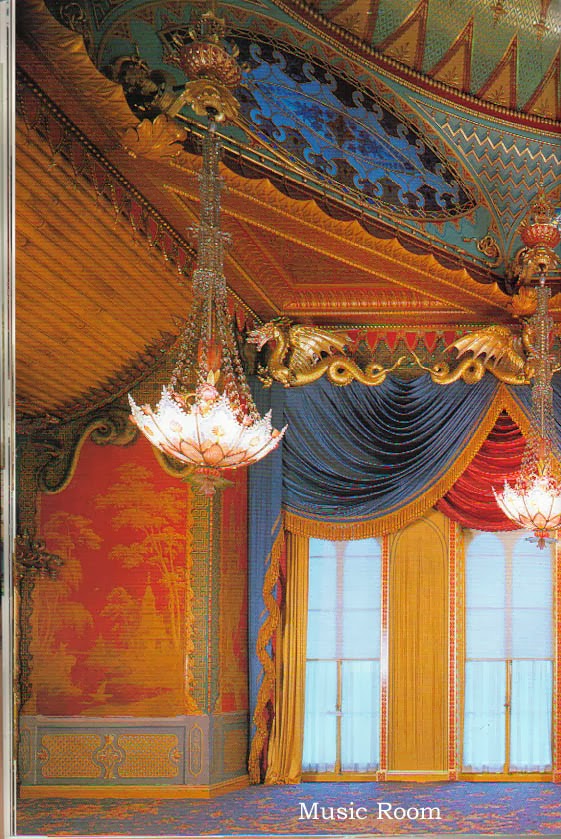
    In the hopes that you will be able to join us at the Brighton Pavilion on the Wellington Tour next September, I will include some other views of the chinoiserie interiors, as a temptation.  Pictures will never quite do justice to the feast for the eye, however.

    Music Room
     
    The Long Gallery
     
    The Banqueting Room
     
    Chandelier Detail
     
    The Great Kitchen
     
    The Great Kitchen was designed with a high ceiling, for dispersal of heat and fumes, incorporated all the latest features for the creation of great banquets.  For a time, it was the "kingdom" of the great chef, Antonin Carême (1784-1833), the first celebrity chef.  Our pal, actor and author Ian Kelly, wrote a biography of Carême. For more information, click here.


    The Brighton Pavilion is now owned and operated by the City of Brighton.  I suppose, after seeing the pictures above, it won't be a surprise that Queen Victoria did not find the place to her liking.  She sold it to Brighton in 1850, though she kept many of the furnishings for use at Buckingham Palace and Windsor Castle.  Over the years, the Pavilion has been restored and developed into a popular tourist site.  Some of the furnishing have been loaned back to the Pavilion by HM The Queen.

    Now here is the question, what did the Duke of Wellington think of it?  The Duke was a loyal servant of the crown and he followed George IV's desires regarding the disposition of his personal effects after the King died.  But one can hardly imagine that the structure appealed to the Duke's tastes any more than it did to Victoria's. Fortunately, we have an account of the Duke's reaction upon first seeing the Pavilion from the letters of Princess Lieven:

    January 26, 1822 - "I wish you were here to laugh You cannot imagine how astonished the Duke of Wellington is. He had not been here before, and I thoroughly enjoyed noting the kind of remark and the kind of surprise that the whole household evokes in a newcomer. I do not believe that, since the days of Heliogabalus, there have been such magnificence and such luxury. There is something effeminate in it which is disgusting. One spends the evening half-lying on cushions; the lights are dazzling; there are perfumes, music, liquers - "Devil take me, I think I must have got into bad company." You can guess who said that, and the tone in which it was said. Here is one single detail about the establishment. To light the three rooms, used when the family is alone, costs 150 guineas an evening; when the apartment is fully opened up, it is double that."

    In any case, the Duke had to spend a great deal of time in Brighton due to Royal summons, and we hope you will enjoy touring it with us.